

Where we walk
Join Derek, Trudie, Sarah and Sheila on a guided seabed walk to Seymour or Icho Towers. Read more about our Bioluminescence walks in Jersey, Oyster Trail, Seaweed foraging, Moonlight (also called Moonwalks), and, on the very lowest tides of the year, The Two Towers and Karame guided walks. We also offer shorter Rockpool Explorations and Beach walks.
Jersey has the largest rocky intertidal area in Europe. This expanse is now an internationally recognised “Ramsar” World Wetlands site (a marine version of the Jersey National Park) and is part of the Jersey Tidal Trail and the proposed Jersey Island GeoPark.
The Dates Page shows our full schedule with links to book online. Contact us for more advice.
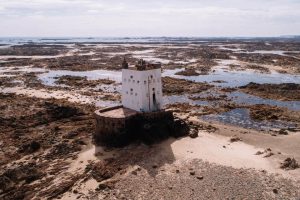
Explore the largest intertidal rocky zone in Europe
Seymour Tower. Walk on the Seabed
Walk on the seabed! Explore gullies, cross sand bars and rock pools on a walk to Seymour Tower (1 mile offshore).
Discover Jersey’s wilderness with local guides who are passionate about the area.
The walks are also called “Moonwalks” because of the lunar-like rock formations. However, this environment is not sterile; it is full of marine and bird life and has a rich maritime history.
Escape the sounds and activities of everyday life and enter a place that is neither sea nor land.
Seymour Tower, built in 1782, dominates the Royal Bay of Grouville. The tower is surrounded by a mass of granite rocks and gullies and is home to a diverse range of marine creatures and birds.
The walk takes you across sand bars and into the gullies, which fall dry at low tide. Stand in places where, within a few hours, up to 40 feet/12 meters of water will cover your footprints as the ocean returns to reclaim its territory.
Learn about maritime history and fishing activities from local guides who have lived and walked in this area for many years. Perhaps observe low-water fishermen and women searching for lobster, prawns and even the famous Jersey ormer.
Throughout the year, discover fascinating marine creatures, sponges, sea lemons, anemones and a wide variety of shellfish and seaweed.
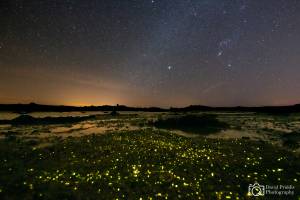
Bioluminescent glowing worms in Jersey.Copyright D Priddis
Twinkle, twinkle, little star. Bioluminescence on a beach
As night descends, star-like shapes of bright green flash and sparkle in a few unique spots on the seabed at low tide to illuminate the sands at your feet. Few local people see or even know about these remarkable creatures.
Walk away from the streetlights and explore a different world where stars sparkle above us and tiny creatures glow at your feet. Dates.
Read about this walk in The Guardian.
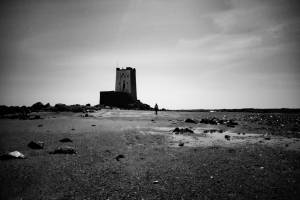
Moonlight Walk to Seymour Tower
Full-Moon-Walk to Seymour Tower
Leave the lights of Jersey behind us as we stroll beneath the rays of the full moon across the seabed.
Join Derek and Trudie on a unique nighttime walk and walk 1 mile offshore to Seymour Tower.
As the tide recedes, walk in a seascape where the reflections of stars twinkle in the rock pools along with the occasional sparkle of bioluminescence*. On a clear night, perhaps catch a glimpse of a shooting star and the Milky Way.
At your feet, observe tiny marine creatures as they scurry about on nocturnal missions while our figures cast moon shadows.
On the nights of a full moon, you may even be able to read a newspaper – though the marine life is perhaps more newsworthy!
*Note. Bioluminescence is much harder to see when it is a full moon. For the best displays of bioluminescence, choose our bioluminescence walks.
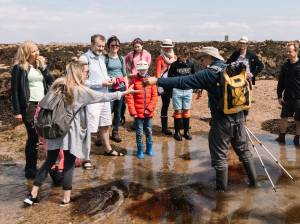 Rock-pool Explorations
Join us on our Rock-pool Exploration to discover the hidden life of rock pools. Accompanied by expert local guides, you’ll discover shellfish, shore crabs, tiny spider crabs, colourful anemones, beautiful starfish, and more!
This 1½-hour walk takes place in the World Wetlands site on Jersey’s southeast coast, where exciting marine discoveries await.
If you make a discovery, our knowledgeable guide will be available with a few reference books.
Suitable for families with children and anyone who wants to explore the incredible world of rock pools.
Dates: This walk is arranged on request, subject to the time of low tide.
Email us or call 07797853033 for more information.
We can customise this walk to suit your needs.
As this is a private walk, we can adapt the exploration to your needs and ages. Contact Trudie to arrange a date.
Dates of all our seabed walks are listed in our Walks diary.
Beach Walk
Discover the rich history and marine life of the southeast coast of Jersey.
Today, this is a World Wetlands Site (Ramsar) and is Jersey’s marine wilderness.
Observe amazing marine life and see oyster farmers harvesting delicious Jersey oysters.
Our expert guides will reveal stories of this seascape, from when you could have walked to France to the landings by French invaders at La Rocque to the attempts by Jersey people in 1944 to escape German occupation by small boats.
Contact us to arrange a date.
The Beach Walk can be arranged on request and is suitable for participants who prefer a shorter walk to explore the upper shore. This walk is also ideal for anyone who wants to discover Europe’s largest rocky intertidal area when the tide is not low enough to explore further offshore.
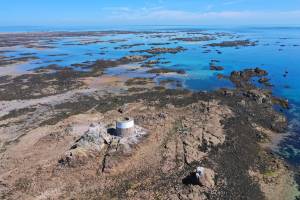
Icho Tower
Icho Tower
Icho Tower is very different from our walk to Seymour Tower. We can only visit Icho Tower on very low tides, so only a few discover its remarkable marine life. It is rare to encounter more than a dozen people out low-water fishing for lobster, prawns, or other shellfish.
Walk through sea gullies, catching glimpses of panoramas that suddenly reveal a mass of reefs and sandbars.
Join local guides who have fished and foraged in this area for many years.
“Having been brought up with Icho Tower on my doorstep, this is the area that most low-water foragers consider Jersey’s best“. Derek Hairon.
The Dates Page shows our full schedule.
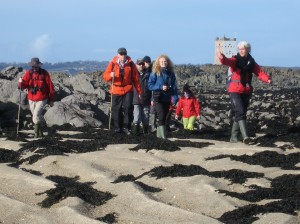
Exploring beyond Seymour Tower to Karame Beacon
Walk to the end of Jersey. Karame Beacon
Walk into a world of bright colours and sensations as we follow the tide almost 2 miles offshore to Karame Beacon and the Violet Bank.
Walk to the edge of Jersey’s wilderness on a very low tide. Only the squawking of seagulls, the sound of the ocean, and a stillness surround us in this exceptional area, which is covered twice a day by some of the highest tides in the world (40ft).
Explore one of Europe’s most remarkable intertidal zones, now an internationally recognised Ramsar world wetlands site. Dates.
The Two Towers. A low tide exploration
Walk between Icho and Seymour Towers on the lowest tides of the year.
Few people experience the opportunity to walk between the two towers. Weave your way between rocks, sandbanks and rock pools accompanied by experienced local guides who have fished and lived on this coast for many years.
Perhaps meet people who are low-water fishing for lobster and shellfish. Dates.
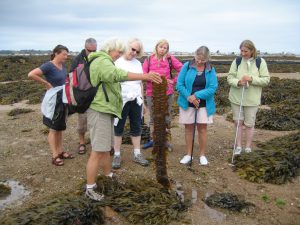
Foraging for edible seaweeds
Wild Vegetables of the Ocean. Seaweed Foraging
Green, brown, delicate, bold, and sometimes smelly, seaweeds often remain unnoticed and are disregarded as useless. Today, however, they are an essential ingredient in sushi, miso soup, jellies, sweets, or squirty cream, and Jersey has a long tradition of gathering them.
Discover the amazing world of seaweed.
Discover their values on a gentle coastal walk with an expert Jersey resident. Dates.
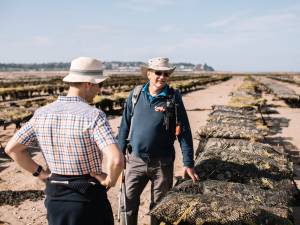
The Oyster Trail
The Oyster Trail
Stroll through the most extensive oyster beds in the British Isles. Hear about the modern cultivation of shellfish in Jersey and the remarkable history of the oyster fishery, a huge local industry in the 19th century.
Afterwards, sample fresh Jersey Oysters at Seymour Inn.
The Dates Page shows our full schedule.
Read more about oysters here.
Sea Foraging & Oyster Trail
Jersey folk used to call it low-water fishing. Today, it’s called foraging.
Join us on a marine wild food foray as we stroll to the biggest oyster beds in the British Isles. Discover what you can forage from the sea and share stories of the 19th-century Oyster fishing, Jersey’s version of a gold rush.
On the way, learn the difference between Praires, Palourdes, Cockles and Clams. All are edible and have surprisingly different tastes.
To add a vegetable side dish to our walk, we’ll introduce you to a few edible seaweeds that are often overlooked or dismissed as useless. They are essential in sushi, miso soup, jellies, sweets and even ice cream.
End the 2½ hour walk with fresh Jersey oysters and a glass of beer/wine in Seymour Inn.
This walk is only available as a private walk. Please contact us for dates and times.
Frequently Asked Questions (FAQ)
Visit our FAQ page or email us if you need more information about our seabed walks.
Departure Points for our Seabed Walks
Map showing our guided walks departure points.
We will confirm the meeting point when you book.